
I am sure there are many things H could stand for, but as I was searching for a topic this week I thought I might want to change things up a bit. And for no reason at all Haggis–that peculiar Scottish treat–came to mind.

Scottish Haggis
What is haggis? Traditionally it is a pudding or sausage made of the “pluck” (lungs, heart, and liver) of a lamb or sheep, mixed with oatmeal, onion, suet, and seasonings, stuffed into the stomach of a sheep and cooked. It is often served with “neeps and tatties,” or turnips and potatoes as we might say.
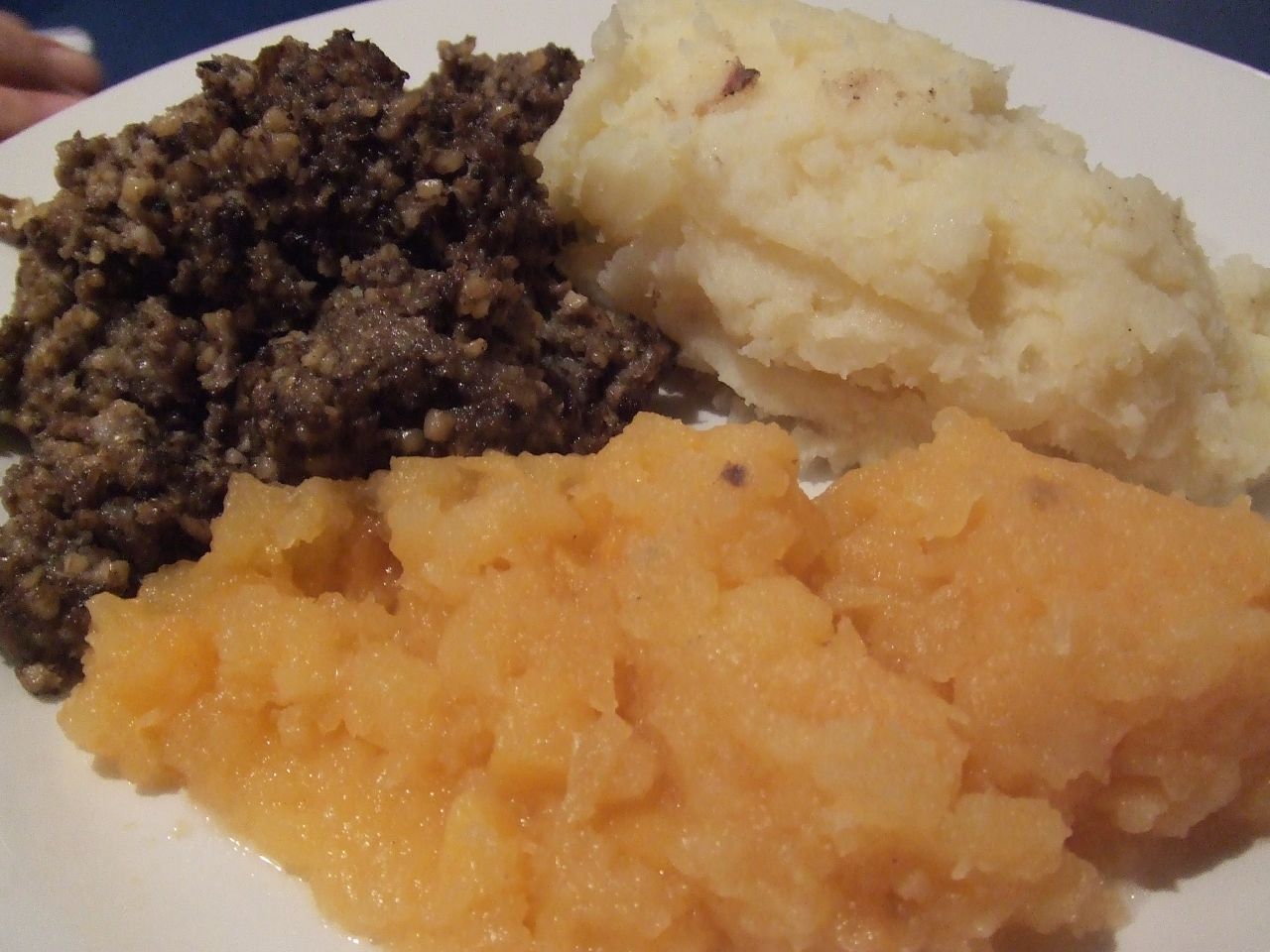
Haggis with neeps and tatties
Ummm. Tasty.
Haggis is usually thought of as a traditional Scottish treat, but according to my research its origins are kind of murky. Mention of a haggis-like dish can be found in Homer’s Odessey –“a man before a great blazing fire turning swiftly this way and that a stomach full of fat and blood, very eager to have it roasted quickly.” The Oxford Companion to Food states that the ancient Romans made a type of viand similar to haggis. And in 2009, historian Catherine Brown found a recipe for the Scottish meal in a 1615 cookbook called The English Hus-Wife.
The Scots, however, are having none of that. Although first mention of haggis in Scotland does not come until 1747, Robert Patrick, a haggis maker, said in an article for BBC News, that claiming haggis as an English dish is tantamount to the Dutch and Chinese claiming to have invented golf. “Anything that’s to do with Scotland, everyone wants to get a part of.”
The most famous reference to the haggis is Robert Burns’ poem, “Address to a Haggis,” which begins:
Fair fa’ your honest, sonsie face, sonsie=jolly
Great chieftain o’ the puddin-race!
Aboon them a’ ye tak your place, Aboon=above
Painch, tripe, or thairm: painch=stomach; thairm=intestine Weel are ye wordy o’ a grace As lang’s my arm.

Robert Burns
“Address to a Haggis”
Every year Burns’ birthday, January 25, is celebrated with a Burns’ Supper where the main dish–a haggis of course– is piped into the dining room by bagpipers and the poem is recited before dinner is served.
Below is a traditional recipe for haggis:
Ingredients:
Set of sheep’s heart, lungs and liver (cleaned by a butcher)

Haggis at a Burns Supper
One beef bung (intestine)
3 cups finely chopped suet
One cup medium ground oatmeal
Two medium onions, finely chopped
One cup beef stock
One teaspoon salt
½ teaspoon pepper
One teaspoon nutmeg
½ teaspoon mace
Method:
Trim off any excess fat and sinew from the sheep’s intestine and, if present, discard the windpipe. Place in a large pan, cover with water and bring to the boil. Reduce the heat and simmer for an hour or possibly longer to ensure that they are all tender. Drain and cool.
Finely chop the meat and combine in a large bowl with the suet, oatmeal, finely chopped onions, beef stock, salt, pepper, nutmeg and mace. Make sure the ingredients are mixed well. Stuff the meat and spices mixture into the beef bung which should be over half full. Then press out the air and tie the open ends tightly with string. Make sure that you leave room for the mixture to expand or else it may burst while cooking. If it looks as though it may do that, prick with a sharp needle to reduce the pressure.
Place in a pot and cover with water. Bring to the boil and immediately reduce the heat and simmer, covered, for three hours. Avoid boiling vigorously to avoid bursting the skin.
Serve hot with “champit tatties and bashit neeps” (mashed/creamed potato and turnip/swede).
Unfortunately, I have not had the “pleasure” of eating haggis. It’s on my bucket list, however, and I’ll be hunting it down the next time I go to Scotland.
Have any of you had the good fortune to partake of this Scottish tradition?







































 Jenna Jaxon Romance--because passion is timeless.