I am extremely pleased and proud to announce that my medieval romance, Betrothal, Book One of Time Enough to Love, has released on Amazon!
To celebrate, I thought I’d introduce you all to my dashing hero. See! G is for Geoffrey Longford. He’s not shy, so be forewarned. 🙂

Jenna: Hello, Sir Geoffrey. Thank you so much for stopping by the Journal today. I thought our readers would be thrilled to be introduced to you, on the day Betrothal releases. I am sure you must be excited. I certainly am.
Geoffrey: There is the air of a tournament about today, Lady Jenna. You have been all atwitter since dawn.
Jenna: Since dawn? How did you know…Geoffrey! You are not to invade my thoughts! All right, tell everyone a bit about yourself.
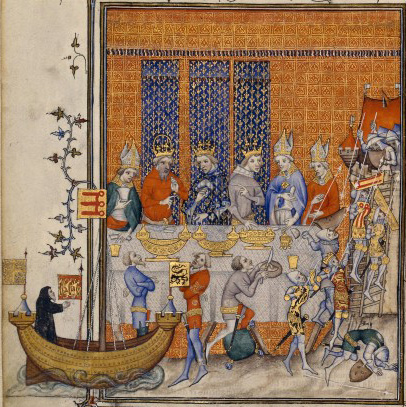
Geoffrey: I am Sir Geoffrey of Longford, second son of the Earl of Longford. I have been a knight in the service of King Edward III ever since attaining knighthood at the age of ten and eight years. I fought along side the Earl of Derby and my friend, the Earl of Braeton, at the Battle of Crecy. For this service I was given a manor house and lands. ‘Tis a small holding, but enough for my needs. And for my prospective bride to be mistress over one day.
Jenna: Excellent segue! How did you meet Lady Alyse de Courcey?
Geoffrey: *chuckles* We were called before the court, in the Great Hall, right in front of the king. Then he simply presented her to me as my betrothed. We had some *clears throat* chat, after that, and she made me promise to be her Hercules. *grins* I managed to accomplish that feat in short order.
Jenna: Hercules? *eyes him up and down* Well, I’d say she got that right! What was your first thought when you saw her?
Geoffrey: That she was the most beautiful creature I had ever beheld. And I wanted to kiss the small mark just above the right corner of her mouth.
Jenna: What is your favorite thing about her?
Geoffrey: I could say it is that self-same mark, for it fascinates and stirs great feelings in me. But in truth it is simply that she is Alyse, kind, gentle, loving, and stubborn at times. Her essence is what I truly love most.
Jenna: What is your greatest fear?
Geoffrey: That I will lose her.
Jenna: What is your greatest strength? Greatest weakness?
Geoffrey: My greatest strength is my resourceful nature. I can reason out any problem and arrive at a solution that satisfies the need. *grins* Ask Alyse about my solution to her Herculean task of stopping the sun in its orbit around the earth. She was scarcely pleased with my answer to the question.
*sighs* My greatest weakness is my love for Alyse. I fear ‘twill be my undoing.
Jenna: What is your favorite color?
Geoffrey: Blue. The exact shade of Alyse’s eyes.
Jenna: If you could spend a whole day with Alyse where would you go and what would you do? Details please! *wink*
Geoffrey: To spend an entire day alone with my lady would be a great boon indeed. We have little time together, despite our betrothed state. *strokes chin.* If I could have her all to myself, we would ride out from the castle, away into the woods. Far from everyone and everything that might tear us from one another. We would come to a clearing. I would spread a cloth on the ground for her to sit upon. Then I would serve her all manner of delicacies and sweetmeats. Feeding her from my own hands. Once she was sated, she might feed me some morsel. I would have need of naught, save her presence. Then we would lay in the woods and…talk. About everything we know not about the other. *winks* A truly resourceful man might find out much.
Jenna: He might at that. *shakes head* If I gave you a box with three items: Bungee cord, Nutella, and a Lolly Pop, what would you do?
Geoffrey: I would ask what these curious items were and what was their purpose.
Jenna: *smiling* Do you wear boxers or briefs?
Geoffrey: *cocks head* I know not of what you speak, but from the merriment in your face and the place your eyes keep straying, I fear there is but the choice of chausses.
Jenna: Okay. *blushes* What is your favorite dessert?
Geoffrey: *chuckles* I will be conventional and answer honeyed pears, though I could answer otherwise and still speak of honey.
Jenna: * flustered* Uh, hard or soft?
Geoffrey: *sharp bark of laughter* Hard
Jenna: *consulting list of questions, hesitates, then cringes as she asks* Fast or slow?
Geoffrey: * a slow grin spreads across his face* Each to its own time, as you so well know, Lady Jenna.
Jenna: *blushing profusely* Uh, maybe…I don’t know…Well, I think that is all for today, Sir Geoffrey. You have been most…informative about yourself and Lady Alyse. I’m sure my readers will want to learn more about you and your…Herculean efforts with Alyse.
Geoffrey: The pleasure has been all mine. *grins wickedly and kisses my hand and I leave quickly* My great thanks for this very…educational experience. And Lady Jenna tells me that another excerpt from Betrothal has been placed on Lady Sheri’s…blog post? Is that something you ride? Ahhh, ’tis called Friday Flames. Perhaps riding of a different sort? *grins wickedly* You may find it at the following “URL” http://sherifredricks.blogspot.com/2013/04/friday-flames-guest-post-jenna-jaxon.html
Lady Jenna, have you revealed something about Lady Alyse that could be considered…unseemly? Lady Jenna? *Geoffrey storms off*
Blurb for Betrothal:
Lady Alyse de Courcy has fallen in love with Lord Braeton, a nobleman in King Edward III’s court and a man to whom she has barely spoken. Fate, however, has decreed her betrothal to his best friend, Sir Geoffrey Longford—a handsome and imposing knight, yet hardly the man she wants to wed.
When Sir Geoffrey is bound in betrothal by his father, he could not have expected the beautiful stranger to win his heart the moment they meet. Nevertheless, the fascinating Lady Alyse has done exactly that, and his feelings for her only grow as he learns more of her gentle yet spirited nature. But Alyse’s infatuation with his friend casts doubt on whether she can ever return his regard and their wedding day is fast approaching…
Will he have time enough to win her love?
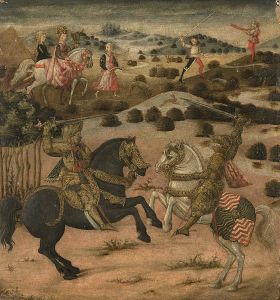
Excerpt for Betrothal:
“What do you require of me, Majesty?” Her mouth so dry she could taste sand, Alyse fought to speak in a normal tone. With a sigh of relief, she dropped into a deep curtsy, hiding her face in the folds of her skirt. If only she could remain bowed thus before His Majesty for the remainder of the evening.
King Edward laughed. “Obedience, Lady Alyse, as I require of all my subjects. As your father requires of his daughter.”
Her heart thumped wildly in her breast. That could mean but one thing.
“Rise, my lady.”
She did so on unsteady feet. “I am ready, as always, Your Majesty, to obey my father as I would you.”
Holy Mary, let it be Lord Braeton.
King Edward lifted an eyebrow toward Alyse. “A very pretty answer, my lady. And are you ready to accept your father’s decree for your betrothal? His messenger has today reached me with the contract, as I am to stand in his stead in this matter.”
 Alyse took a deep breath and hoped her voice did not tremble. “Yea, Majesty, I will obey my father.”
King Edward nodded and leaned over to whisper something to Queen Phillipa, who sat beside him, heavy with their twelfth child.
Mere seconds before she learned her fate. She could scarce affect an indifferent pose before the court when inside every inch of her quivered with anticipation of the name. His name, pray God, on the king’s lips.
Thomas.
In her mind, she heard the word.
The king straightened, glanced at her then at the man by her side.
“What say you then, Sir Geoffrey? Does the lady not speak fair? I vow she will make you a proper wife and a dutiful one as well.”
Alyse turned, until that moment unaware that Geoffrey Longford stood beside her. Chills coursed down her body as the king’s words echoed in her mind. The sensation of falling backward assailed her, as though she rushed away from the tall man at her side even as his figure loomed larger and larger in her sight.
Not Lord Braeton.
Her numbed brain repeated the phrase, trying to comprehend that instead he would be her husband. Geoffrey Longford.
God have mercy on me, for by the look of him, this man will not.
Fearful, she cringed as her gaze climbed higher, over his chest, over his chin, finally resting on the dark blue eyes turned toward her.
Geoffrey returned her appraisal, his gaze sweeping her figure as a smile crept over his face. “Your Majesty.” He spoke to the king but his attention remained fixed on Alyse. “When my father told me of the betrothal contract before I left his home, I resolved to play the dutiful son. Now, however, I find I do not wish to act that role after all.” His eyes held hers as he paused.
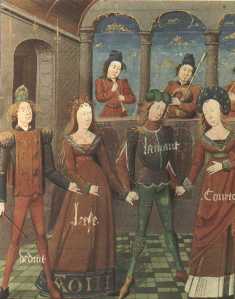
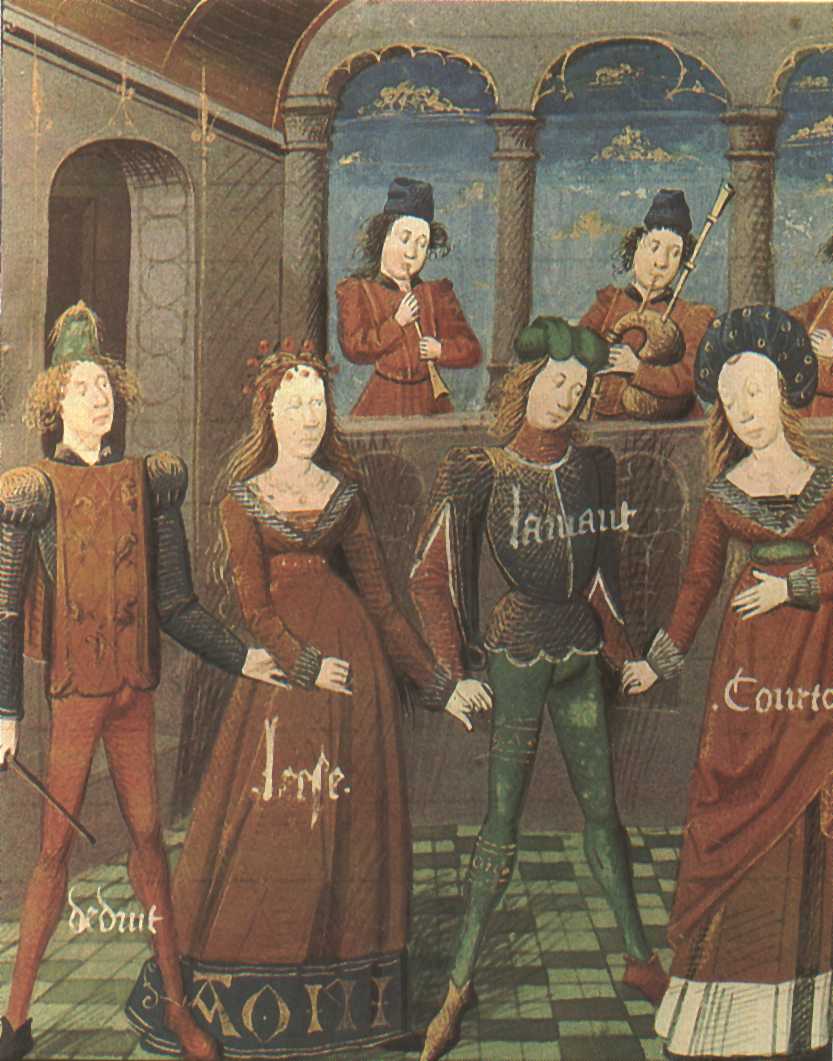
Mirth and Gladness Lead
A Dance in The Roman de la Rose
Dear God, does he mean to renounce me here before the entire court?
Alyse stared at the man beside her, willing herself to remain upright, despite the waves of ice and fire alternating through her body.
“Now I find I would rather play the ardent lover.”
An amused murmur ran through the Hall at his words. Sir Geoffrey grinned, his eyes sparkling with humor and something more. Despite the uneven light, Alyse saw an unfathomable promise in their dark depths. She took a shaky breath and looked away.
Betrothal is currently available at Smashwords.