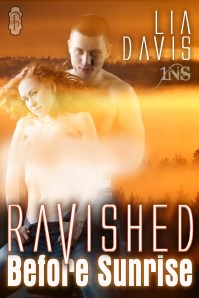
Happy Monday! I have the great pleasure today of introducing you to a great writer whose debut novella, Ravished Before Sunrise, will be released tomorrow from Decadent Publishing! Lia, it’s so wonderful to have you here on the Journal to celebrate your release. Thank you for coming and for bringing your…friends. The more the merrier. *eyes Darien and Emalee hesitantly*
I’ll jump right in Lia. What was your inspiration for this story?
Hi, Jenna. Thanks for having us over today. I started out wanting to write a vampire series, but I haven’t nailed my world down quite the way I want. When I heard about the 1Night Stand series and read some of the stories, I had to see if writing one was as fun as reading them. And it was! And I’m going to do it again.
Good for you! I had a blast writing mine. I do love creating character names. Are the character names in Ravished Before Sunrise special in any way?
Not particularly. I had Emalee picked out a while back and didn’t know what to do with her until I decided to write Ravished Before Sunrise. And Darian just fit my vision of him.
*darts glance at Darian* I can quite see that. Uh, Darian, how difficult is it to juggle your vampire life with running a company? I mean, do your employees know they’re working for someone who’s…undead? Do you have rules about not drinking employee’s blood? Do you only work at night?
*He chuckles* We aren’t undead as most believe. Vampires are a subspecies of demons, a cousin to the incubi and succubi. And yes, the employees who work closest to me know what I am. They are told upon accepting the job. If they are uncomfortable with me being a vampire, their memory is altered and they are relocated to another office.
I don’t feed off unwilling humans, ever. And never at the office. Now that I have my Ema, I don’t need to hunt either. *he lifts Ema’s hand to his mouth and places a soft kiss in her palm*
Being the boss gives me more freedom, but working during the day doesn’t bother me as long as I stay out of direct sunlight. Our skin is sensitive, but it doesn’t burst into flames.
Oh. That’s a good thing, right? Gives you more flammability…I mean, flexibility. *blushes. turns to Emalee* Well, then, Emalee. How did you come to find out about the 1Night Stand service? What led you to seek such a service? And were you pleased with the results?
My best friend told me about 1Night Stand. I have no idea where she heard about it, nor did I care at the moment. *she laughs* I had to move into the local witch coven because I’m not fully human and can’t draw too much attention to myself. Well at least before meeting Darian.
*Darian wraps an arm around her shoulders and pulls her closer to him*
I am very pleased with the results.
*raises eyebrows* So I see. Now, Lia, who has been the greatest influence on your writing?
My critique group and writing partner are big influences in my writing. I have learned so much from them and get awesome support.
Yes, CPs are the best! *shuffles her notecards* Uh, Darian, I noticed in my notes that you have a daughter. So, you’ve been married before? Can you tell us a little about your daughter?
Yes, Katrina is my natural daughter from my late wife, Alexis. She’s the VP of Wyman Enterprises and keeps everyone in line, including me. She also is the reason I have Ema.
So the whole situation was quite a family affair! It’s nice when everyone gets along. And sort of on that note, Emalee, what qualities do you find most attractive in a man and why?
Oh, I like everything about a man. But the most attractive thing is his eyes. They tell you so much about the man inside.
They do indeed. *glances into Darian’s eyes. can’t look away. finally he blinks and she snaps out of it. shakes her head* Definitely the most arresting feature. *shakes herself* Now I have some questions for all three of you to answer.
What is the most exciting/daredevil thing you’ve ever done?
Lia: The most exciting was when my son was born.
Ema: Signing up for a one-night stand.
Darian: You don’t want to know. Besides I’d rather leave the past where it belongs.
*gulps* If you could have one wish granted just for you (not world peace, LOL), what would you wish for?
Lia: To be able to stay at home fulltime. I’m working on it. *wink*
Ema: I got my wish. *kisses Darian*
Darian: Yep, me too. *hugs Ema tight*
*sigh* And now for the most important question: boxers, briefs, or commando?
Lia: Boxer briefs
Ema: Depends on my mood, but mostly commando.
Darian: Which ever my love is in the mood for.
*clears throat* Thank you so much, Lia, Darian and Emalee, for taking time out of your busy schedule to come talk with me today. Lia, I understand you’re doing a giveaway here on Jenna’s Journal today.
Yes, as part of my two week self promoted blog tour — which starts today, 4/30, and goes through 5/11 — I’ll be selecting daily winners at each stop for a signed swag pack. At the end of the tour I select a grand prize winner of a $25 Amazon GC and signed swag.
Be sure to leave your email address in you comment to enter and follow the tour. For a list dates and locations go to http://www.authorliadavis.com/events/.
All winners will be notified by email.
Ravished Before Sunrise will be available May 1, 2012 at Decadent Publishing.

Excerpt:
Emalee’s pulse raced as she drummed her fingers on her desk and searched the website. A giddiness she hadn’t known since senior prom ran through her. The site claimed unlimited possibilities, a chance for adventure. Could they mean it? Because she’d already seen things beyond what humans deemed possible. Hell, her whole existence was unimaginable.
Her life had taken a lonesome turn when a friend she hadn’t seen since high school noted how much younger than the rest of her classmates she looked. Her long-lasting youth had become a liability. Drawing too much attention to her unusual gift wouldn’t prove wise. In some cases, it could get her killed. With no alternative, she’d closed the door on her life among humans and moved into the local witch coven, where everyone was different.
“What will you do?” Her best friend since preschool, a coven member in good standing, sat next to her for moral support and encouragement. Ema didn’t need much encouragement. The second Beth had mentioned a one-night stand, she’d been hooked. And Madame Eve’s dating service would save her from dying of boredom, at least for one night.
But could she go through with it? A wicked smile tugged at her lips and her inner voice said, “Hell, yeah.” Human strangers gave her a sense of safety. They knew nothing about her past or her unusual abilities.
“Just one night?”
About Lia
Lia Davis is a mother to two young adults and two very special, equally different kitty cats. She’s a wife to her soul mate, who drives her crazy during editing/revisions. She and her family live in Northeast Florida battling hurricanes and very humid summers. But it’s her home and she loves it!
An accounting major, Lia has always been a dreamer with a very activity imagination. The wheels in her head never stop. She only recently became serious about publishing her work and loves it more than she imagined. Writing is a stress reliever that allows her to go off in her corner of the house and enter into another world she created, leaving the day job where it belongs.
Her favorite things are spending time with family, traveling, reading, writing, chocolate, coffee, nature and hanging out with her kitties.
Website / Facebook / Twitter / Goodreads



 Come on over and let me know what your favorite lucky charm is!








































 Jenna Jaxon Romance--because passion is timeless.