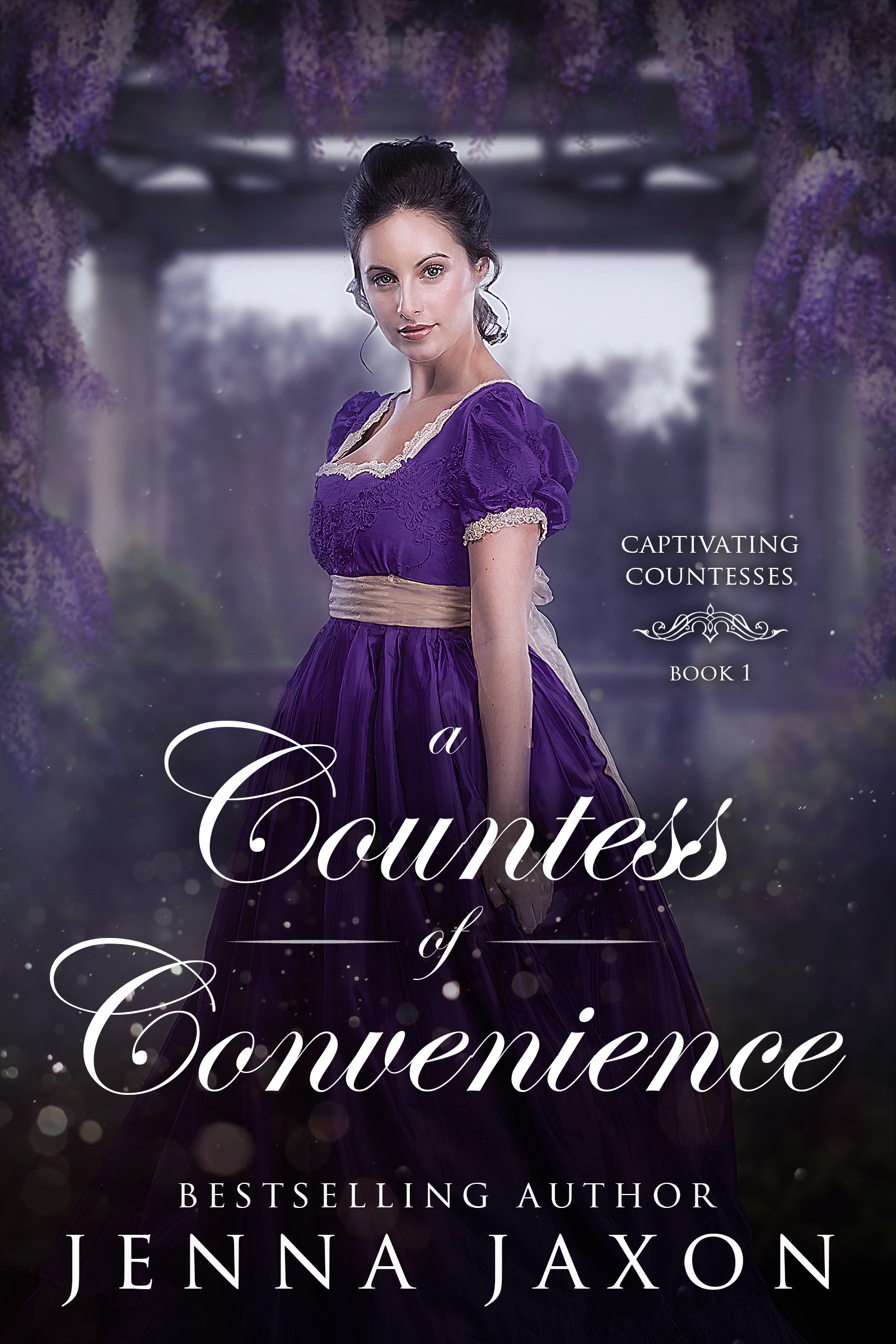

Recently, Jenna Jaxon wrote several excellent posts on the making of a hero. I asked her for space to give a rebuttal, but then realized she was right. It also explains why I did what I did in book 3, Coming to Reason.
How to Build a Hero: Part I ~ Physique
How to Build a Hero: Part II ~ Features
How to Build a Hero: Part III ~ Characteristics
She quotes a higher authority, Louis P. Pojman, who claims a hero is a person with moral integrity, a lack of fear, and self-control.
Trent, my ‘hero’ of the first two books of A Long Road to Love, frankly shows none of those traits. Well, perhaps ‘lack of fear’ but only because he has a bullet proof limousine and an excellent lawyer on retainer.
However, he did risk his life once pulling my heroine to safety from a large filing cabinet falling from five stories above. To explain why he saved Carrie, and why it doesn’t count as bravery, let’s look at the world according to Trent:
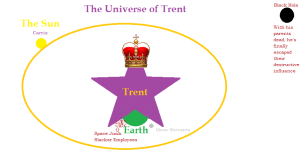
As you can see, Trent is the most important thing on earth…to Trent. He has many servants who try to make his days go by without any discomforts. They are the moon. His slacker employees constantly annoy him, which makes them space junk.
Trent had remained in a state of perpetual dissatisfaction until he hired Carrie as his Executive Assistant. Carrie is his warm cheery sun, rotating AROUND HIM. Without her, his life is dreary, cold and irritating as hell.
This is why, without a thought to his own safety, he saved his sun (Carrie) before it got obliterated by a giant hunk of space junk. (Bad employee and her five nephews pushing a cabinet out the window.) However, one could reasonably say he did it for himself. (Earth would be a miserable place without its sun.)
Which, I suppose, is why no one gives him credit for his heroic deed.
This series is highly divisive. 80 percent of readers thought Worst Week Ever hilarious, while the other 20 percent hated it and rightly claimed the two main characters needed therapy.
I can’t argue with the point that Trent makes a crappy hero and Carrie too willing to forgive.
Look at Jenna’s heroes and then look at Trent.
Even when he improves in Book Two, deep down, he’s still selfish. And that personality trait is what blows up their relationship in Book Three, and why it’s called Coming to Reason.
It’s not just Carrie that needed to come to reason. I, Liza O’Connor, the author, needed to face the fact that the man I created, with the history I gave him would NEVER be good enough for my heroine, whose main flaws are being overly forgiving and having a desperate need to be needed, which she incorrectly correlates to being loved.
For Trent to change, he requires a life-altering nuclear explosion to put him on a different path.
And to make Carrie wake up and smell the coffee, it has to be a devastation beyond the pale. One that will convince her he has never loved her. Otherwise, she’ll just forgive him and continue to ignore a far better guy I found for her.
Sending Trent into mass destruction mode proved very easy. I just had to let Coco do her thing and then Trent’s selfish determination to preserve HIS happiness wreaked havoc beyond my wildest imagination.
For some of you, when I leave Trent lying on a sidewalk, you’ll be so mad at him, you won’t care if he lives or dies. Carrie deserves a real hero…like the ones Jenna Jaxon describes. A man with flaws but with integrity and genuine love, who focuses on the heroine rather than himself.
But a great many of you will feel betrayed and hurt. You fell in love with Trent in Book 2. He might be a crappy hero, but, by God, you love him anyway. Me too.
Still, I had to break them apart. Their relationship was not healthy for either of them. To get them both to HEAs, they had to split, only neither would give up on the relationship without a disaster beyond forgiveness.
Trent’s nuclear explosion is the only way Carrie could open her eyes and see a true hero who would love her the way she deserved. And Trent: he had to lose Carrie, to hit rock bottom, before he could fundamentally turn himself into a new and better man, a hero per Jenna’s definition. Finally, in Book Four, we will discover the man Carrie always saw inside Trent. A man worth loving. A man you’ll admire.
Breakups are hard and painful, but sometimes they are the only way for people to reach their full potential. This is true both in real and fictional life.

COMING TO REASON
Book Three: A Long Road to Love
Humorous Contemporary Disaster Romance
Blurb
Book 3 of A Long Road to Love series
Carrie has committed to an inter-species engagement with Trent, her billionaire boss. Presently, he is eighty percent dreamboat and twenty percent nightmare. When he fires her so they can become a normal couple, everything heads south.
Providing her a stark contrast, her new boss, Dan Marshal, is everything a woman could want. But for Carrie, her heart is taken and thus, her path to reason remains long and arduous.
When her relationship with Trent explodes in a shocking fashion, finally her heart gives up and reason takes over. She realizes a brighter future and a better man has been at her side all this time. But can she overcome the obstacles in her path to secure him? Or is Carrie doomed to never know true love?
Warning: If you loved Carrie and Trent as a couple, this book may break your heart.
Liza O’Conner writes books that speak to my soul. Carrie is a character you will not soon forget.
–Rebecca Royce, author of The Warrior series.
I only have one thing to say about Liza O’Connor’s A Long Road to Love series: Read them. They’re funny. You won’t regret it!
—Maria Hammarblad, author of Kidnapped.
Excerpt
Monday morning, Carrie stood outside Dan Marshal’s resource firm, wearing her best blue suit. She’d arrived early, knowing Dan kept to a tight schedule. She smiled as his car pulled to the curb.
Dan let himself out of the limo, something Trent still wouldn’t do, and headed to the office door. His brow remained furrowed until his gaze settled on her, then a smile brightened his handsome face.
“Carrie! What a pleasant surprise.” Leaning down, he kissed both her cheeks in greeting. While Dan didn’t possess Trent’s height, he still towered over her. “Are you by chance wishing to speak to me?”
“If you have time.”
He glanced at his watch and the furrows in his brow returned. “Fifteen minutes, before a meeting I’ve called. If you need more time, hopefully, you can wait an hour for the meeting to be finished.”
“More than fair since I didn’t make an appointment.”
His head tilted as he studied her. “Which is unlike you.”
“True, but I didn’t know I needed a job until yesterday, when Trent decided the time had come for him to grow up and run his own company.”
Dan led her to the elevator with his hand rested on her back. “Really?” His tone turned happy upon discovering her state of unemployment, but she let it slide.
“Evidently, he made the decision a while back, but didn’t bother to share it with me until yesterday.”
Dan’s smile grew more pronounced, borderline celebratory.
Once they entered the elevator and the doors closed, she wrinkled her nose at him. “Well, I’m glad my unemployment makes you happy. I expected a stern lecture after the last time I asked you to get me an interview.”
His smile disappeared. “Good point. Is this a real job you want, or are you trying to get rid of one of Trent’s groupies?”
She laughed. “Trent doesn’t have groupies. And this is a real job I want. We’ve decided to become a normal couple with daily time off from each other. Otherwise, Trent will continue to rely on me too much.”
For some reason, her reply saddened him.
Links
A Long Road to Love
Book One
Worst Week Ever
Amazon
“Love this book and couldn’t stop laughing from beginning to end.” 5 stars – Alves – Amazon
67 reviews: 4.3 stars
Book Two
Oh Stupid Heart
Amazon
“Be warned though, this book is completely different from The Worst Week Ever. Yes, there is still humor, dry wit, situations that you would think…NOT AGAIN but this one humanizes Trent more.” 5 stars – Brian’s Mom – Amazon
8 reviews: 4.8 stars
Book Three
Coming to Reason
Amazon
Other Books by Liza O’Connor
Saving Casey
Ghost Lover
Liza O’Connor
Author Bio:
Liza lives in Denville, NJ with her dog Jess. They hike in fabulous woods every day, rain or shine, sleet or snow. Having an adventurous nature, she learned to fly small Cessnas in NJ, hang-glide in New Zealand, kayak in Pennsylvania, ski in New York, scuba dive with great white sharks in Australia, dig up dinosaur bones in Montana, sky dive in Indiana, and raft a class four river in Tasmania. She’s an avid gardener, amateur photographer, and dabbler in watercolors and graphic arts. Yet through her entire life, her first love has and always will be writing novels. She loves to create interesting characters, set them loose, and scribe what happens.
FOR MORE INFORMATION ABOUT
LIZA O’CONNOR & UPCOMING BOOKS:
Liza’s Blog and Website Facebook Twitter
Prizes:
Tour prize: a $50 Amazon Gift Card
Gift at every stop for one lucky commenter
Must request book in comments
& leave email address:
Worst Week Ever or
Oh Stupid Heart ebook.
Enter to Win $50 Amazon Gift Card
a Rafflecopter giveaway